Leaving a Job:
Tax, P45 & Refunds
Last reviewed: April 2026
Leaving a job can trigger a tax refund, a P45 issue and pension decisions — all at once. Here is what to do and what to check.
At a glance
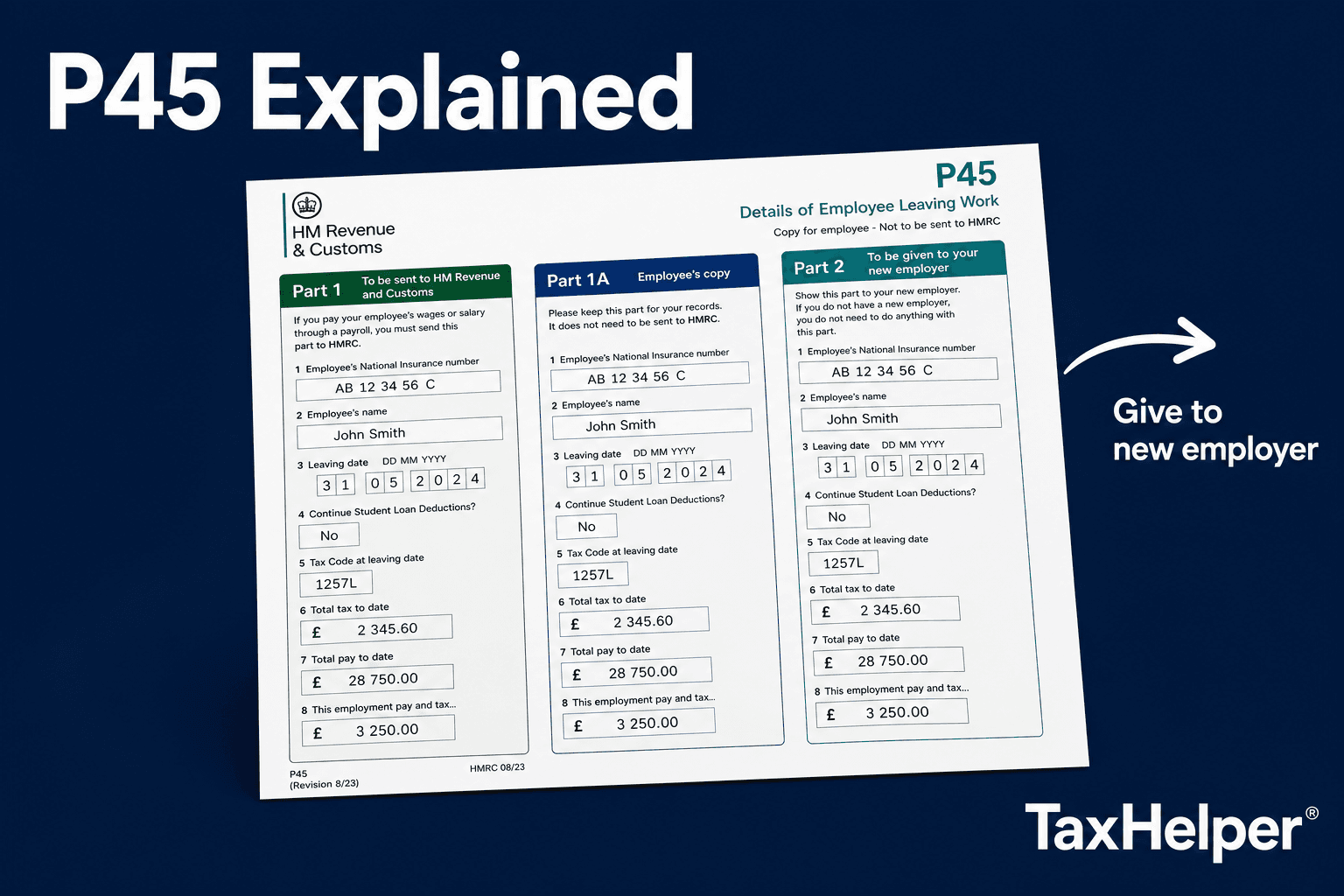
- ✓Your employer must give you a P45 on your last day or final payment date
- ✓If you do not start a new job before 5 April, you may have overpaid tax and can claim it back
- ✓Redundancy payments up to £30,000 are tax-free; amounts above are taxed as income
- ✓Workplace pension pots remain yours — leave them, transfer them or consolidate
Your final payslip: what to check
Your final payslip should show your gross pay for the final period, all deductions (income tax, NI, pension), and your final net pay. Check that the tax deducted looks proportionate to your earnings in that period — and that any holiday pay owed has been included.
If you are leaving mid-month, your final pay will usually be pro-rated. Check the calculation: if you left on the 15th of a 30-day month, your gross pay should be roughly 50% of your usual monthly salary (plus any additional payments agreed in your contract).
Common final payslip errors to watch for
- • Holiday pay owed not included or calculated incorrectly
- • Notice pay treated as a lump sum rather than spread over the notice period
- • Overpaid salary deduction without written agreement
- • Wrong NI or tax deduction on redundancy payment
Could you be owed a tax refund?
PAYE assumes you will earn the same amount for the entire tax year. If you leave a job in, say, November and do not immediately start a new one, you have only earned income for 7 of the 12 months. HMRC will automatically recalculate at year end and issue a P800 if you overpaid.
You do not have to wait until year end. If you know you will have no further employment income before 5 April, you can contact HMRC to claim a refund now. Have your P45 ready — it shows your cumulative pay and tax figures for the year.
How to claim overpaid PAYE taxRedundancy payments and tax
Statutory redundancy pay is calculated using your age, length of service and weekly pay (capped at £643/week for 2026/27). The first £30,000 of your total redundancy package (including any ex-gratia payment) is tax-free. Any amount above £30,000 is taxed as employment income at your marginal rate.
Critically, the excess above £30,000 is not subject to National Insurance. This is why large redundancy payments are more tax-efficient than equivalent salary — you save 8% NI on everything above £30,000.
Full redundancy pay guideWhat happens to your workplace pension?
Your auto-enrolled pension pot belongs to you. When you leave, contributions stop but the pot continues to be invested. You have three options:
- 1
Leave it in place
The simplest option. The provider keeps managing it. Watch out for ongoing charges — some older workplace schemes have higher fees than newer ones.
- 2
Transfer to your new employer's scheme
If your new employer has a good scheme (especially if they offer higher employer contributions), transferring can simplify your retirement savings.
- 3
Transfer to a personal pension (SIPP)
Gives you more investment control but more responsibility. Make sure the SIPP charges are lower than your current scheme.
Frequently asked questions
Frequently asked questions
When should I receive my P45?
Your employer must give you your P45 on or before your last day of employment, or by the date of your final payment — whichever comes first. If you have not received it within a week of leaving, chase payroll directly. HMRC cannot force employers to issue P45s faster, but can take action for persistent failures.
Can I get a tax refund if I leave part way through the tax year?
Yes — if you leave without starting a new job before 5 April, you may have overpaid tax because PAYE assumes you will earn the same amount for the full year. You can claim a refund by contacting HMRC directly or by waiting for an automatic P800 reconciliation after the tax year ends.
What happens to my workplace pension when I leave?
Your pension pot stays where it is and continues to grow. You have three main options: leave it with the existing provider, transfer it to a new employer's scheme, or transfer to a personal pension. You cannot access it until at least age 57 (rising to 57 in 2028).
I am being made redundant — is my payment tax-free?
Statutory redundancy pay and most ex-gratia payments are tax-free up to £30,000. The portion above £30,000 is subject to income tax (but NOT National Insurance). Payments in lieu of notice (PILON) are always fully taxable as employment income.