UK tax codes explained
Your tax code tells your employer how much income tax to deduct from your pay each month. Getting it wrong costs you money - either too much deducted now, or a surprise bill later. Here is everything you need to know.
Analyse your tax code
Type your code exactly as it appears on your payslip or P60.
How to read your tax code
The number
Multiply by 10 to get your approximate tax-free Personal Allowance for the year. So "1257" means £12,570 tax-free.
The letter
"L" is standard. "M" means you receive Marriage Allowance from your partner. "N" means you have transferred Marriage Allowance to your partner. "T" means HMRC needs to review your code.
W1 or M1 suffix
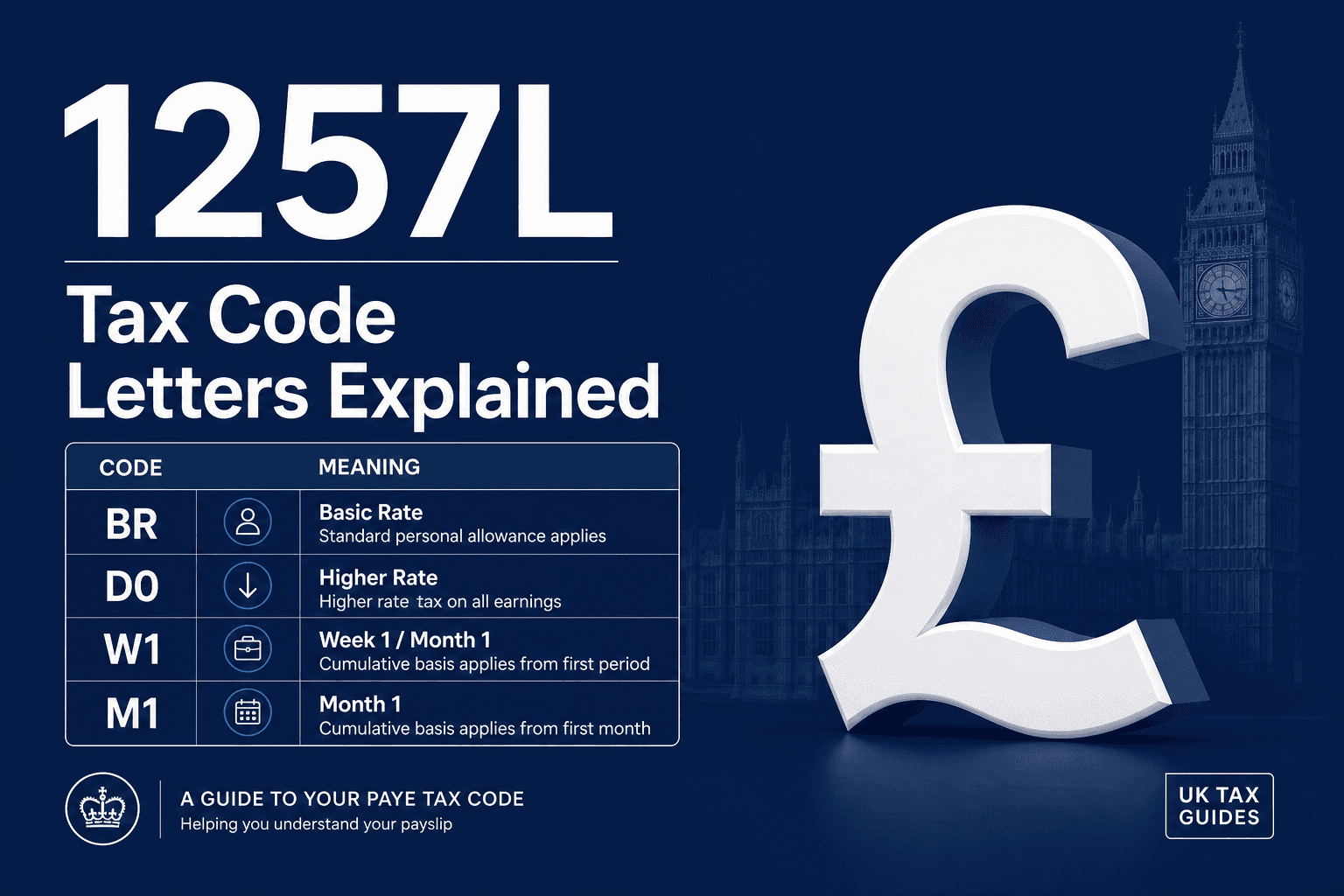
Week 1 or Month 1 basis - non-cumulative. Tax is calculated as if each pay period is the first of the year. Usually temporary.
K prefix
A K code works in reverse - the number represents the amount added to your income before tax, not subtracted. £200 extra tax-equivalent income per year for K20.
Example: 1257L
1257 = £12,570 tax-free allowance per year. L = standard allowance, no special circumstances. You pay income tax only on earnings above £12,570.
Example: K497
K = negative allowance. 497 = £4,970 is added to your income before tax is calculated. This happens when benefits in kind or underpayment collection exceed your Personal Allowance.
Types of tax code at a glance
The most common code. You get the full Personal Allowance of £12,570.
Non-cumulative. Tax is calculated fresh each week or month — common in a new job without a P45.
All income taxed at 20%. Usually applied to a second job or pension where the allowance is used elsewhere.
All income taxed at 40% (D0) or 45% (D1). Used for second sources of income in higher rate bands.
No Personal Allowance — every pound is taxed. Applied when no starter information is available or allowance is fully used.
No tax deducted at all. Rare — used for specific exempt situations.
Your deductions (benefits in kind, prior underpayments) exceed your Personal Allowance — extra tax is added to each payment.
Scottish income tax rates apply. E.g. S1257L means the same allowance but Scottish bands.
Welsh income tax rates apply. Otherwise works the same as the equivalent England/NI code.
Signs your tax code might be wrong
Any of these ring a bell?
Your code is lower than 1257L and you have no obvious benefits in kind
You see W1 or M1 after the number and you have been at the job more than a month
Your code is BR but this is your main and only job
You receive a P800 letter showing you significantly overpaid
You switched jobs and your new employer never received your P45
How to correct a wrong tax code
Check your Personal Tax Account
Sign in at gov.uk and go to 'Check your tax code'. HMRC shows a full breakdown of why your code is what it is — including any benefits in kind, Marriage Allowance, or prior year adjustments.
Update incorrect information online
If a benefit in kind has ended, your income estimate is wrong, or a marriage allowance transfer is missing, you can correct most of these directly in your Personal Tax Account without calling.
Call HMRC if needed
For anything that cannot be fixed online, call the Income Tax helpline on 0300 200 3300 (Monday to Friday, 8am to 6pm). Have your National Insurance number and P60 ready.
HMRC issues a new coding notice
Once corrected, HMRC sends a P2 coding notice to you and your employer. Your employer updates the code from the next payroll run. Any overpaid tax from earlier in the year is refunded automatically through your payslip.
All tax codes
Search by code or description. Click any code for the full explanation.
Zero personal allowance — income above £125,140 removes the allowance entirely under the taper.
Full detailsNo personal allowance — every pound is taxed. Assigned when HMRC has no starter information or allowance is fully used.
Full detailsNo personal allowance, calculated on a Month 1 basis.
Full detailsNo personal allowance, calculated on a Week 1 basis.
Full detailsReduced personal allowance of £10,000.
Full detailsReduced personal allowance of £10,500.
Full detailsReduced personal allowance of £11,000 — likely due to benefits in kind or a prior-year underpayment being collected.
Full detailsStandard personal allowance (£12,570). The most common tax code — used by most employees and pensioners.
Full detailsStandard allowance on a Month 1 (non-cumulative) basis. Tax is calculated afresh each month, not cumulatively.
Full detailsStandard allowance on a Week 1 (non-cumulative) basis. Tax is calculated afresh each week, not cumulatively.
Full detailsStandard personal allowance plus 10% Marriage Allowance transferred from a partner (total ~£13,830).
Full detailsStandard personal allowance minus 10% Marriage Allowance transferred to a partner (total ~£11,310).
Full detailsPersonal allowance subject to HMRC review. Numerically the same as 1257L but flagged for review.
Full detailsEnhanced personal allowance of £13,830 — most commonly seen after receiving Marriage Allowance.
Full detailsIncreased personal allowance of £15,000 — may reflect additional relief such as professional expenses built into the code.
Full detailsReduced personal allowance of £5,000.
Full detailsReduced personal allowance of £8,000.
Full detailsReduced personal allowance of £9,000.
Full detailsBasic Rate — all income taxed at 20%. No personal allowance applied.
Full detailsBasic Rate on a Month 1 non-cumulative basis.
Full detailsBasic Rate on a Week 1 non-cumulative basis.
Full detailsWelsh equivalent of 0T — no personal allowance, Welsh rates apply.
Full detailsWelsh equivalent of 1257L — full personal allowance but Welsh income tax rates apply.
Full detailsWelsh 1257L on a non-cumulative Week 1 basis — emergency code.
Full detailsWelsh Basic Rate — all income taxed at the Welsh basic rate. No personal allowance.
Full detailsWelsh Higher Rate — all income taxed at the Welsh higher rate. No personal allowance.
Full detailsHigher Rate — all income taxed at 40%. No personal allowance applied.
Full detailsAdditional Rate — all income taxed at 45%. No personal allowance applied.
Full detailsK codes represent a negative Personal Allowance — income is added to your taxable pay rather than deducted from it.
Full detailsK code — £1,000 added to taxable income. Often reflects a small benefit in kind exceeding the Personal Allowance.
Full detailsK code — £2,000 added to taxable income.
Full detailsK code — £3,000 added to taxable income.
Full detailsK code — £4,970 added to taxable income. Common example given by HMRC.
Full detailsK code — £5,000 added to taxable income.
Full detailsMarriage Allowance recipient — you receive 10% of your partner's Personal Allowance.
Full detailsMarriage Allowance transferor — you have given 10% of your Personal Allowance to your partner.
Full detailsNo Tax — no income tax is deducted. Used in specific exempt circumstances.
Full detailsScottish equivalent of 0T — no personal allowance, Scottish rates apply.
Full detailsScottish equivalent of 1257L — full personal allowance but Scottish income tax rates apply.
Full detailsScottish 1257L on a non-cumulative Month 1 basis — emergency code.
Full detailsScottish 1257L on a non-cumulative Week 1 basis — emergency code.
Full detailsScottish Basic Rate — all income taxed at the Scottish basic rate (20%). No personal allowance.
Full detailsScottish Higher Rate — all income taxed at the Scottish higher rate (42%). No personal allowance.
Full detailsScottish Top Rate — all income taxed at the Scottish top rate (47%). No personal allowance.
Full details