Student Loans &
Tax in the UK
Last reviewed: April 2026
Student loan repayments are taken through PAYE alongside your tax and NI. Here is how each plan works, what the thresholds are, and what actually appears on your payslip.
At a glance
- ✓Plan 1 repayments start when income exceeds £24,990 (9% on the excess)
- ✓Plan 2 threshold is £27,295; Plan 5 is £25,000 from 2026/27
- ✓Repayments are written off after 25–40 years depending on your plan
- ✓Student loan deductions do not appear on your P60 — check your payslips
How student loan repayments work
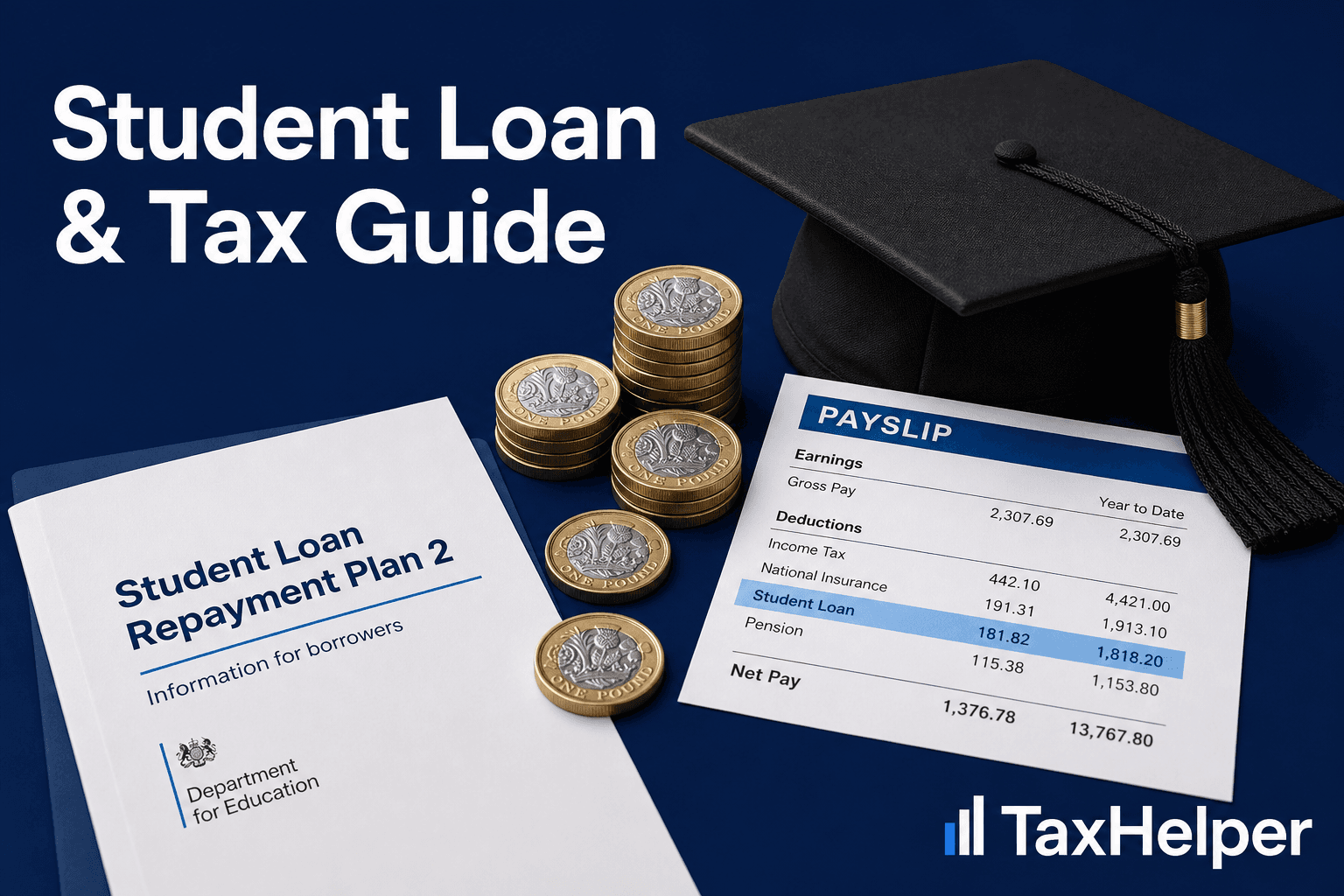
Student loan repayments are not like a traditional loan repayment. You do not have a fixed monthly payment. Instead, you repay a percentage of your earnings above a threshold — and if you earn below the threshold, you pay nothing. This system continues until either the loan is repaid in full or the write-off period expires.
Your employer deducts repayments from your gross pay through PAYE, in the same process as income tax and National Insurance. The deductions appear on your payslip as a separate line — typically labelled "Student Loan".
Importantly, student loan repayments are calculated on gross pay, before pension contributions are removed. However, pension contributions made via salary sacrifice reduce your gross pay before the repayment is calculated — which is one reason salary sacrifice pensions are especially valuable for people repaying student loans.
Example: Plan 2 repayment on a £35,000 salary
Student loan plans: thresholds and rates 2026/27
Your plan type depends on when and where you studied. Check your loan documentation or the Student Loans Company if you are unsure.
| Plan | Who it applies to | Threshold | Rate | Write-off |
|---|---|---|---|---|
| Plan 1 | Started before 1 Sep 2012 (England/Wales); Scottish students before 1998 | ~£24,990/yr | 9% | 25 years or age 65 |
| Plan 2 | Started on or after 1 Sep 2012 (England/Wales) | £27,295/yr | 9% | 30 years |
| Plan 4 | Scottish students who started on or after 1998 | ~£31,395/yr | 9% | 30 years or age 65 |
| Postgraduate Loan | Postgraduate Masters or Doctoral loans | £21,000/yr | 6% | 30 years |
Key things to know about student loan repayments
Repayments are not voluntary
Once your income exceeds the threshold, repayments are compulsory and deducted by your employer. You cannot choose to pause or reduce them (except by reducing your income).
Multiple loans can be deducted simultaneously
If you have both an undergraduate loan and a postgraduate loan, both can be deducted at the same time — potentially 9% + 6% = 15% on income above the postgraduate threshold.
Changing jobs resets PAYE but not the loan
Your repayments continue through your new employer. Make sure your new employer knows your plan type — if they do not, you may be deducted at the wrong rate and have to reclaim.
Salary sacrifice reduces repayments
Making pension contributions via salary sacrifice reduces your gross pay before student loan repayments are calculated. This is an efficient way to reduce both your tax bill and your loan repayments.
Overpayments can be refunded
If you overpay in a tax year — perhaps because your income varied, you had two jobs, or your employer used the wrong plan — you can claim a refund from the Student Loans Company after the year ends.
Interest accrues separately
Interest is added to your loan balance regardless of whether you are repaying. For Plan 2, interest is currently set at RPI + up to 3%. Your repayments first cover interest before reducing the principal.
Frequently asked questions
How are student loan repayments calculated?
Student loan repayments are calculated as a percentage of your earnings above a threshold, not on your total income. For Plan 2, you repay 9% of income above £27,295/year. For Plan 1, you repay 9% of income above £24,990/year. Repayments are deducted by your employer through PAYE alongside income tax and NI.
What are the student loan repayment thresholds for 2026/27?
For 2026/27: Plan 1 threshold is approximately £24,990/year; Plan 2 threshold is £27,295/year; Plan 4 (Scotland) threshold is £31,395/year; Postgraduate Loan threshold is £21,000/year (6% above threshold).
Do student loan repayments show on my payslip?
Yes. Student loan repayments appear as a separate deduction on your payslip, distinct from income tax and National Insurance. They are collected by HMRC through PAYE and passed to the Student Loans Company.
When do student loans get written off?
Plan 1 loans are written off when you reach 65, or 25 years after the April you first became liable to repay, whichever comes first. Plan 2 loans are written off 30 years after the April you first became liable to repay. Plan 4 loans are written off when you reach 65 or 30 years after first repayment, whichever comes first.
Sources
See your full pay breakdown including student loan
Our salary calculator includes all student loan plans — enter your plan type and salary to see exactly what you take home.