Second Job Tax — Complete Guide
Last updated 11/06/2026
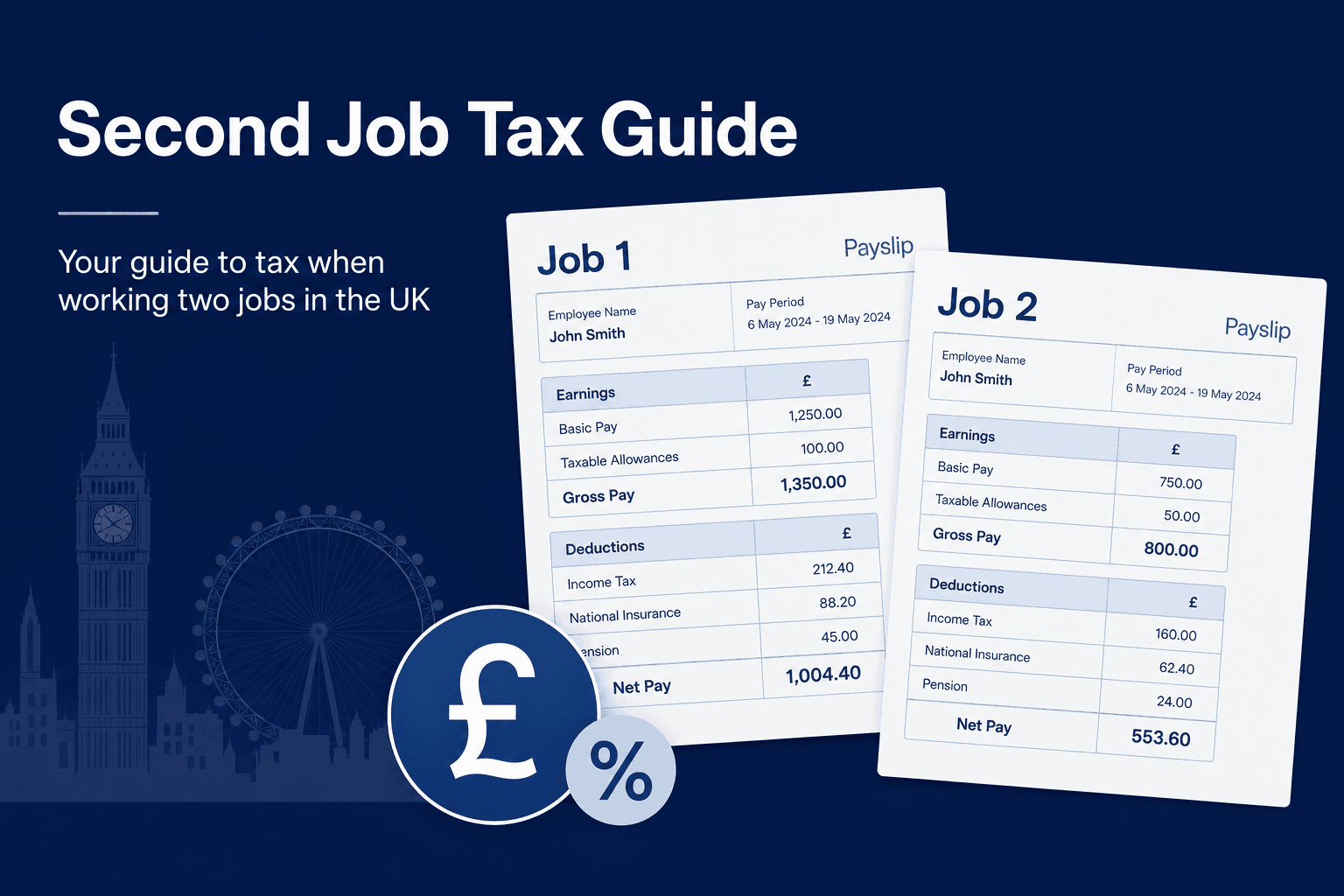
More than five million people in the UK hold more than one job. Whether your second income comes from a weekend shift, a freelance project, or a small side business, PAYE still applies — but the rules are different. Here is everything you need to know.
The Personal Allowance Can Only Be Used Once
Every UK taxpayer gets one Personal Allowance — £12,570 in 2026/27. You can only apply it against one source of income. HMRC assigns your full standard allowance (code 1257L) to your main employment — usually the job where you earn most — and gives your second job code BR (basic rate, 20% on all earnings) or D0 (40%) if your combined income reaches the higher-rate band.
This is correct and expected. It is not you being taxed twice. You will pay exactly the same total income tax as someone earning the combined sum in a single job.
BR vs D0 — Which Code Should Your Second Job Have?
| Tax code | Rate applied | When it applies |
|---|---|---|
| BR | 20% on all earnings | Second job income keeps you in the basic-rate band after combining both jobs |
| D0 | 40% on all earnings | Second job income falls wholly in the higher-rate band (combined earnings exceed £50,270) |
| D1 | 45% on all earnings | Second job income falls wholly in the additional-rate band (very high earners) |
For most people with a moderate second income, BR is correct. You will almost never see D0 unless your main job already takes you close to or above £50,270.
Worked Example: £28,000 Main Job + £10,000 Second Job
Let us work through the numbers for a nurse with a main NHS salary and weekend work at a private clinic.
| Main job (1257L) | Second job (BR) | Total | |
|---|---|---|---|
| Gross salary | £28,000 | £10,000 | £38,000 |
| Personal Allowance | £12,570 | £0 | £12,570 |
| Taxable income | £15,430 | £10,000 | £25,430 |
| Income tax (20%) | £3,086 | £2,000 | £5,086 |
| Employee NI (8%) | ~£1,234 | ~£800 | ~£2,034 |
| Net pay | ~£23,680 | ~£7,200 | ~£30,880 |
For comparison, a single employee earning £38,000 with code 1257L would also pay approximately £5,086 in income tax. The total tax bill is identical — just split across two payrolls.
National Insurance on Two Jobs
This is where the situation differs from a single employment. National Insurance is calculated independently by each employer — they do not know about your other job. Each employer applies the NI thresholds (Primary Threshold £12,570/yr, Upper Earnings Limit £50,270/yr) separately to your earnings from them alone.
In the example above, both jobs sit between the Primary Threshold and Upper Earnings Limit, so each employer deducts 8% employee NI on eligible earnings. You will pay the correct total NI overall, but if either job puts you above the UEL, you may temporarily overpay NI and need to claim a refund from HMRC after the tax year ends.
If your combined earnings exceed £50,270, contact HMRC to request a NI deferral (form CA72A). This tells your secondary employer not to collect NI above 2%, preventing double deduction at the upper rate.
BR Code on Your Only Job — Emergency Tax
BR is not correct if it appears on your only source of income. This happens when:
- You started a new job without a P45 and did not complete a Starter Checklist
- You ticked Statement C on the Starter Checklist by mistake (implying another job exists)
- HMRC has not yet processed your employment details
On a £35,000 salary, BR costs you approximately £847 more in income tax annually compared to 1257L. Fix it by giving your employer your P45, completing a corrected Starter Checklist, or updating your details via your Personal Tax Account.
Self-Employed Side Income
If your second income comes from freelancing or self-employment rather than a second PAYE job, the rules are different:
- Income below £1,000 is covered by the Trading Allowance — no tax or reporting required
- Profits above £1,000 require a Self Assessment tax return
- Class 4 National Insurance applies to self-employment profits above £12,570 (8% up to £50,270; 2% above)
- Class 2 NI applies if profits exceed £12,570 (notional £3.45/week contribution built into Self Assessment)
Your PAYE employment and self-employment income are combined when HMRC calculates your overall tax position. If your combined income pushes you into the higher-rate band, you will pay 40% on the relevant portion of self-employment profit too.
How to Tell HMRC About a Second Job
HMRC usually finds out when your new employer submits RTI (Real Time Information) payroll data. But you should proactively update your details through your Personal Tax Account or by calling 0300 200 3300, especially if:
- You want to split your Personal Allowance differently between jobs
- Your combined income now crosses into the higher-rate band
- A previous job is still showing as active in HMRC's records
Claiming a Refund If You Overpaid
If you overpaid because of an incorrect code, HMRC will usually issue a P800 refund notice after the tax year ends (typically June to October). You can also claim earlier via your Personal Tax Account. Refunds are usually paid directly to your bank account within five working days.
Use our compare salaries tool to model the exact take-home pay across both jobs and spot any discrepancy with your actual payslips.