National Insurance — Complete Employee Guide
Last updated 11/06/2026
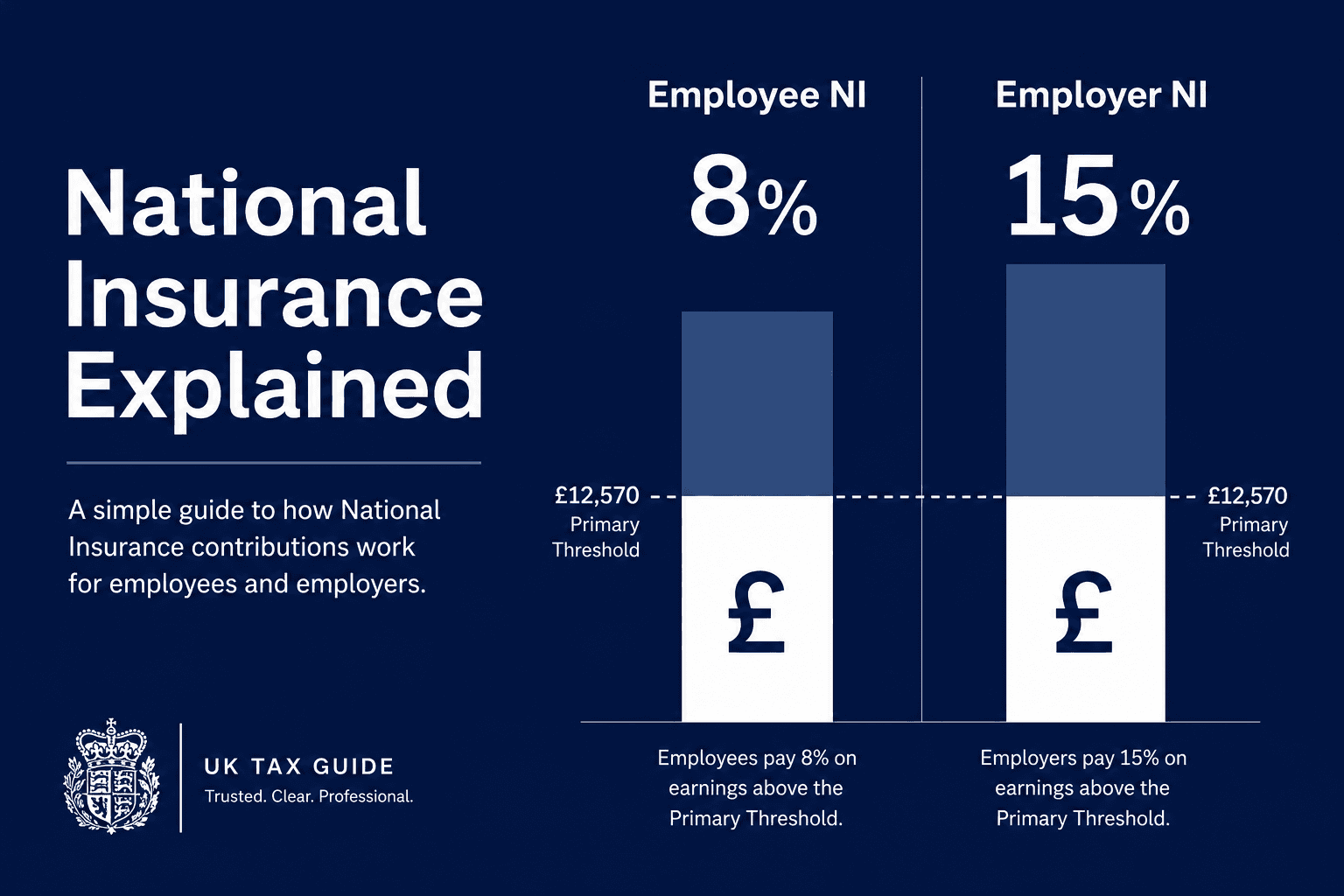
National Insurance (NI) is deducted from your pay alongside income tax, but it works very differently. Understanding it helps you plan for retirement and spot errors on your payslip.
What National Insurance Pays For
NI contributions go into the National Insurance Fund and pay for:
- The State Pension (requires 35 qualifying years of NI for the full amount of £221.20/week in 2026/27)
- Jobseeker's Allowance and Employment and Support Allowance
- Statutory Maternity and Paternity Pay
- NHS funding (partially)
Class 1 Employee NI — 2026/27 Rates
| Earnings threshold (annual) | Category A rate |
|---|---|
| Below £12,570 (Lower Earnings Limit — LEL to Primary Threshold) | 0% (but you earn a qualifying year if earnings are above the LEL of £6,396) |
| £12,570 to £50,270 (Primary Threshold to Upper Earnings Limit) | 8% |
| Above £50,270 (above Upper Earnings Limit) | 2% |
NI is calculated independently each pay period — unlike income tax, there is no cumulative adjustment across the year. This means a high-bonus month generates more NI than the same total paid evenly.
NI Category Letters
The category letter on your payslip determines which NI rates apply to you:
| Category | Who it applies to |
|---|---|
| A | Standard employee — most workers |
| B | Married women or widows with a valid reduced-rate election (Certificate of Election) |
| C | Employees over State Pension age — no NI deducted |
| D | Category A employee, deferring NI because they have another job already paying maximum NI |
| F | Ocean-going mariners — reduced rate |
| H | Apprentices under 25 — employer NI exempt up to UEL |
| M | Employees under 21 — employer NI exempt up to UEL |
| X | Employee not liable for NI (e.g. non-UK resident on short-term contract) |
Employer National Insurance
Your employer also pays NI on your earnings — from April 2025 this is 15% on earnings above the Secondary Threshold of £5,000/yr. This is in addition to your employee NI and does not appear on your payslip, but it is part of the total cost of employing you. A £30,000 salary costs your employer approximately £33,750 in NI alone.
Building Your State Pension Record
Each tax year in which you earn between the Lower Earnings Limit (£6,396) and the Primary Threshold (£12,570) counts as a qualifying year even though you pay 0% NI. Earnings above the Primary Threshold also count. To get the full new State Pension you need 35 qualifying years; a partial pension requires at least 10.
Check your NI record at gov.uk/check-national-insurance-record. You can fill gaps voluntarily (Class 3 NI, £17.45/week in 2026/27) if you have missing years — this is often excellent value if you are short of qualifying years approaching retirement.
National Insurance and Your Payslip
Your payslip should show your NI category letter, your NI number, and the employee NI deducted that pay period. Use our salary calculator to verify the correct deduction for your gross pay. If your payslip shows category B but you are not married or do not hold a valid Certificate of Election, contact payroll immediately — you may be paying too little, creating a future tax debt.
Self-Employment NI
Self-employed people pay Class 4 NI at 8% on profits between £12,570 and £50,270, and 2% above. Class 2 NI (£3.45/week equivalent) applies on profits above £12,570. From 2024, Class 2 is notional — it no longer has to be paid separately but is included in your Self Assessment calculation. See our self-employed calculator for exact figures.