Scottish vs English Income Tax — What Employees Should Know
By TaxHelper Editorial · Last updated 11/06/2026
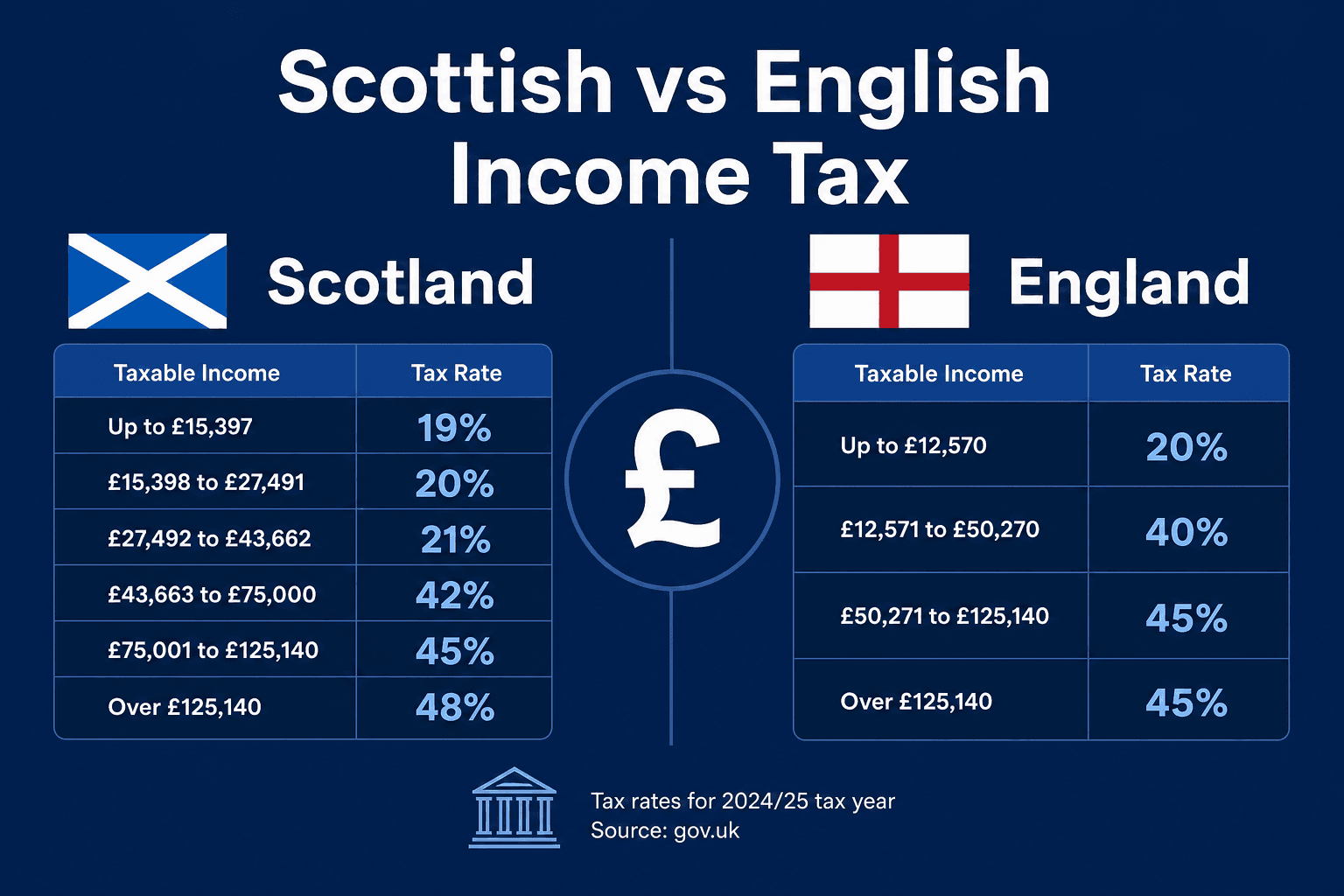
Scotland has its own income tax rates — set by Holyrood, not Westminster. For employees, the practical question is simple: does living in Scotland cost you more in tax? For most people above £30,000, the answer is yes. Here is a precise breakdown for 2026/27.
Why Scotland Has Different Income Tax Rates
The Scotland Act 2016 gave the Scottish Parliament the power to set income tax rates and bands for Scottish taxpayers. The Scottish Government has used this power to create a more progressive structure with six bands, compared to the three-band system used in England and Wales. The Personal Allowance (£12,570) is the same throughout the UK — it is set by Westminster and the Scottish Parliament cannot change it.
National Insurance is also set by Westminster and is identical in Scotland and England. The only difference is income tax on non-savings, non-dividend income (essentially employment income, self-employment profits, and rental income).
2026/27 Rate Comparison
| Band | Scotland | England & Wales |
|---|---|---|
| Up to £12,570 (personal allowance) | 0% | 0% |
| £12,571–£15,397 (starter rate) | 19% | 20% (basic) |
| £15,398–£24,487 (Scottish basic) | 20% | 20% |
| £24,488–£43,662 (intermediate) | 21% | 20% |
| £43,663–£50,270 | 42% | 20% |
| £50,271–£75,000 (higher) | 42% | 40% |
| £75,001–£125,140 (advanced) | 45% | 40% |
| Over £125,140 | 48% | 45% |
Worked Examples at Three Salary Levels
£30,000 Salary
Scotland: £537 (starter) + £1,818 (basic) + £1,158 (intermediate) = £3,513. England: £3,486. Difference: +£27/year in Scotland. At this salary, the 1% intermediate band barely moves the needle — Scottish workers save at the starter-rate band, then pay slightly more at intermediate.
£45,000 Salary
Scotland: £537 + £1,818 + £4,027 + £562 (higher rate on £43,663–£45,000) = £6,944. England: £6,486. Difference: +£458/year (or £38/month) in Scotland. The Scottish intermediate rate (21% vs 20%) and the early introduction of the 42% band start to have a real impact here.
£60,000 Salary
Scotland: £537 + £1,818 + £4,027 + £6,862 (42% on £43,663–£60,000) = £13,244. England: £11,432 (basic rate on lower band + 40% higher rate). Difference: +£1,812/year (or £151/month) in Scotland. The 42% Scottish higher rate versus England's 40% creates a substantial and growing gap.
The S Tax Code
HMRC identifies Scottish taxpayers by adding an S prefix to their tax code. The most common Scottish code is S1257L — the Scottish equivalent of the standard 1257L used in England and Wales. Your employer uses the S prefix to apply Scottish rates through their payroll software.
Residency for Scottish income tax is determined by where your main home is, not where you work. A commuter who lives in Edinburgh and works in Manchester is a Scottish taxpayer. A commuter who lives in Carlisle and works in Glasgow is an English taxpayer.
If you have recently moved to or from Scotland, check your payslip tax code. If it has not been updated within a few weeks, log into your Personal Tax Account and update your address. HMRC will then issue a corrected code to your employer.
What This Means If You Are Offered a Job Across the Border
When comparing job offers in Scotland vs England, do not compare headline salaries without factoring in the tax difference. A £52,000 job offer in Edinburgh versus a £50,000 job in Manchester are not straightforward to compare — at those salaries, the Edinburgh role results in paying more income tax (42% on income above £43,662 vs 40% in Manchester), partially offsetting the higher nominal salary.
Use our Scotland vs England comparison guide for full worked examples at multiple salary levels, or our compare salaries tool to model your exact situation.