Second Job Tax UK
Last reviewed: April 2026
Taking on a second job? You only get one personal allowance, so your second income is taxed differently. Here is exactly how it works — and how to make sure you are not paying too much.
At a glance
- ✓Your personal allowance (£12,570) applies to your main job only
- ✓Second job income is usually taxed at BR (20%), D0 (40%) or D1 (45%)
- ✓If your second income pushes you over £50,270, you will pay 40% tax on the excess
- ✓Keep National Insurance in mind — both jobs charge NI independently
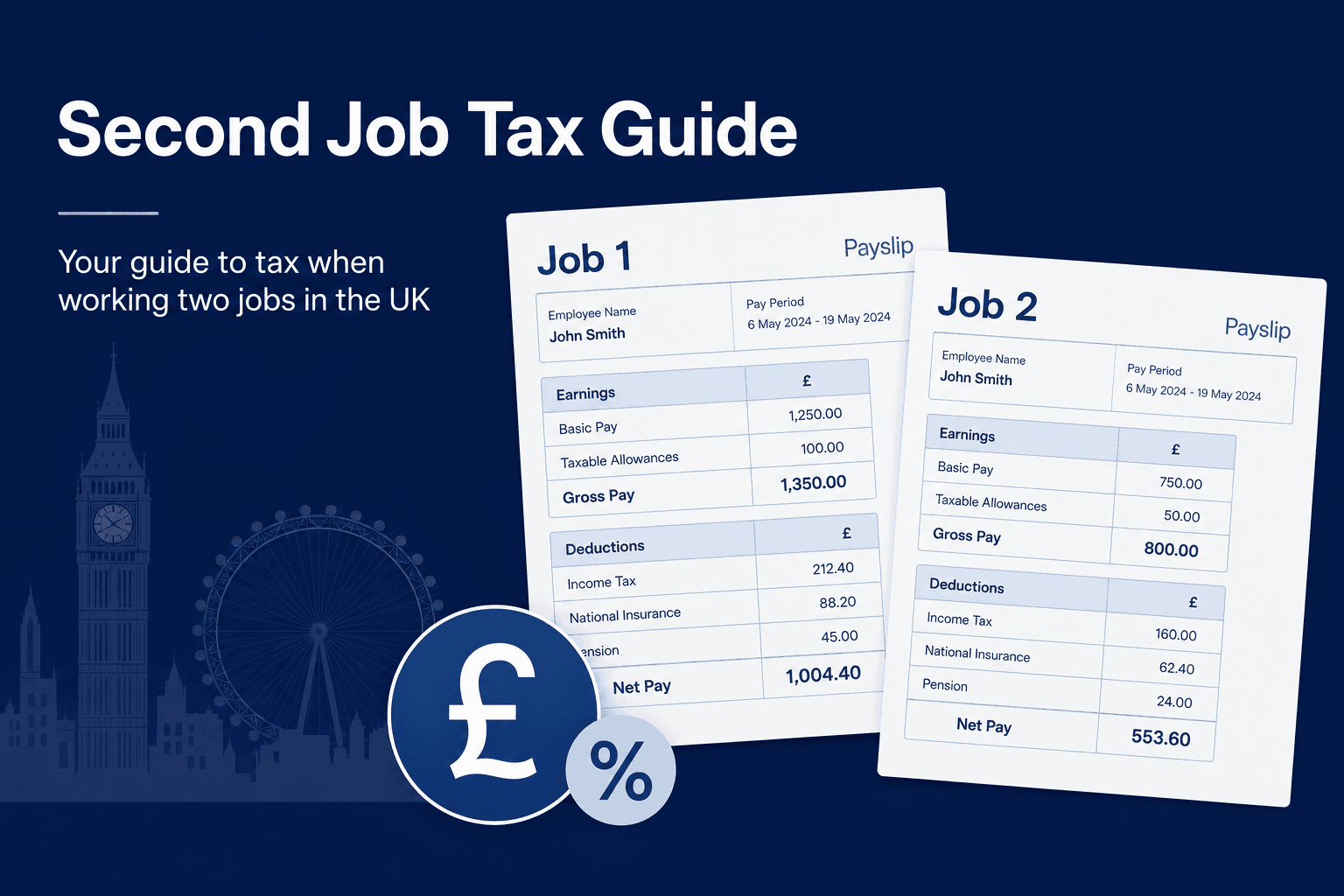
Why your second job is taxed more heavily
The UK personal allowance of £12,570 can only be used once. HMRC typically allocates your entire personal allowance to your main (primary) employer. This means your second employer has no personal allowance to apply — so every pound you earn there is subject to income tax from the first penny.
Your combined income from both jobs is still taxed at the correct overall rate — it is just that the way it is spread between the two employers can cause over- or under-payment during the year. HMRC reconciles this at year end.
Example: how two jobs are taxed
Same total tax as if you earned £33,000 from one employer — the allocation between jobs does not change the total bill.
Second job tax codes explained
Basic Rate
20% tax on all earnings from this employment. Used when your first job already uses your personal allowance and your total income is below £50,270.
Higher Rate
40% tax on all earnings. Used when your first job already fills the basic rate band (income over £50,270). Every pound from the second job is taxed at 40%.
Additional Rate
45% tax on all earnings. Applied when your total income already exceeds £125,140.
Zero allowance
No personal allowance — all income taxed at the relevant rate. Often applied as a temporary code at the start of employment before HMRC issues the correct code.
National Insurance on a second job
NI is calculated per job, not combined
Each employer calculates and deducts NI independently. This means you might pay NI on both jobs even if your combined earnings are modest. However, you can apply for a refund of excess NI contributions after the tax year if your combined earnings cause you to overpay.
If your second job earnings are low (below £12,570 per year from that job alone), you may not pay NI on the second job at all. The NI primary threshold is applied to each employment separately.
How to avoid overpaying tax on two jobs
Tell HMRC about both jobs
HMRC needs to know about both employments to issue the right tax codes. They usually find out automatically once both employers submit their payroll returns, but calling HMRC directly (0300 200 3300) speeds up the process.
Ask HMRC to split your personal allowance
If both jobs are regular and the income is predictable, you can request HMRC split your personal allowance between the two employers. Each will get part of the allowance, reducing the amount of emergency or basic-rate coding on your second income.
Check your P800 after the year
HMRC sends P800 letters when they calculate you have overpaid or underpaid tax. If you overpaid because of the way your two incomes were coded, HMRC will refund the difference — usually by cheque or through an adjustment to next year's code.
Keep both payslips
Always keep payslips from both jobs. If there is a discrepancy when you file your Self Assessment (or HMRC does their reconciliation), you need evidence of what was actually deducted.
Frequently asked questions
How is a second job taxed in the UK?
Your personal allowance (£12,570 in 2026/27) is usually allocated to your main job. Income from your second job is taxed from the first pound — normally at 20% (code BR) if your combined income is below £50,270, or 40% (code D0) if your first job already uses all of the basic rate band.
What tax code will I have on my second job?
Most second-job employees are put on code BR (basic rate — 20% on all earnings) or D0 (40% on all earnings) or D1 (45%). The exact code depends on your total income. HMRC will usually assign the correct code once they know about both employments, but you can call HMRC to confirm.
Do I pay National Insurance on a second job?
Yes. National Insurance is calculated separately for each employment. You pay employee Class 1 NI on each job's earnings independently. However, there is an annual maximum for NI contributions — if your combined earnings take you significantly over £50,270 you can reclaim the excess after the tax year.
Can I split my personal allowance between two jobs?
Yes. You can contact HMRC and ask them to split your personal allowance across both employments. This can reduce overpayment if your second job earnings are steady. HMRC will issue both employers with new tax codes reflecting the split.
Sources
Model the tax on your two incomes
Use our compare tool to run both jobs side by side and see exactly what you will take home from each.