How Are Bonuses
Taxed in the UK?
Last reviewed: April 2026
Expecting a bonus? It is taxed as ordinary income — but PAYE can make the deduction look eye-wateringly high. Here is what is actually happening and how to legitimately reduce the tax.
At a glance
- ✓Bonuses are taxed as regular income at your marginal rate (20%, 40% or 45%)
- ✓Your employer aggregates your bonus with regular pay under PAYE
- ✓Paying your bonus into a pension is the most tax-efficient option
- ✓If you are pushed into the 40% band, only the excess is taxed at 40%, not all of it
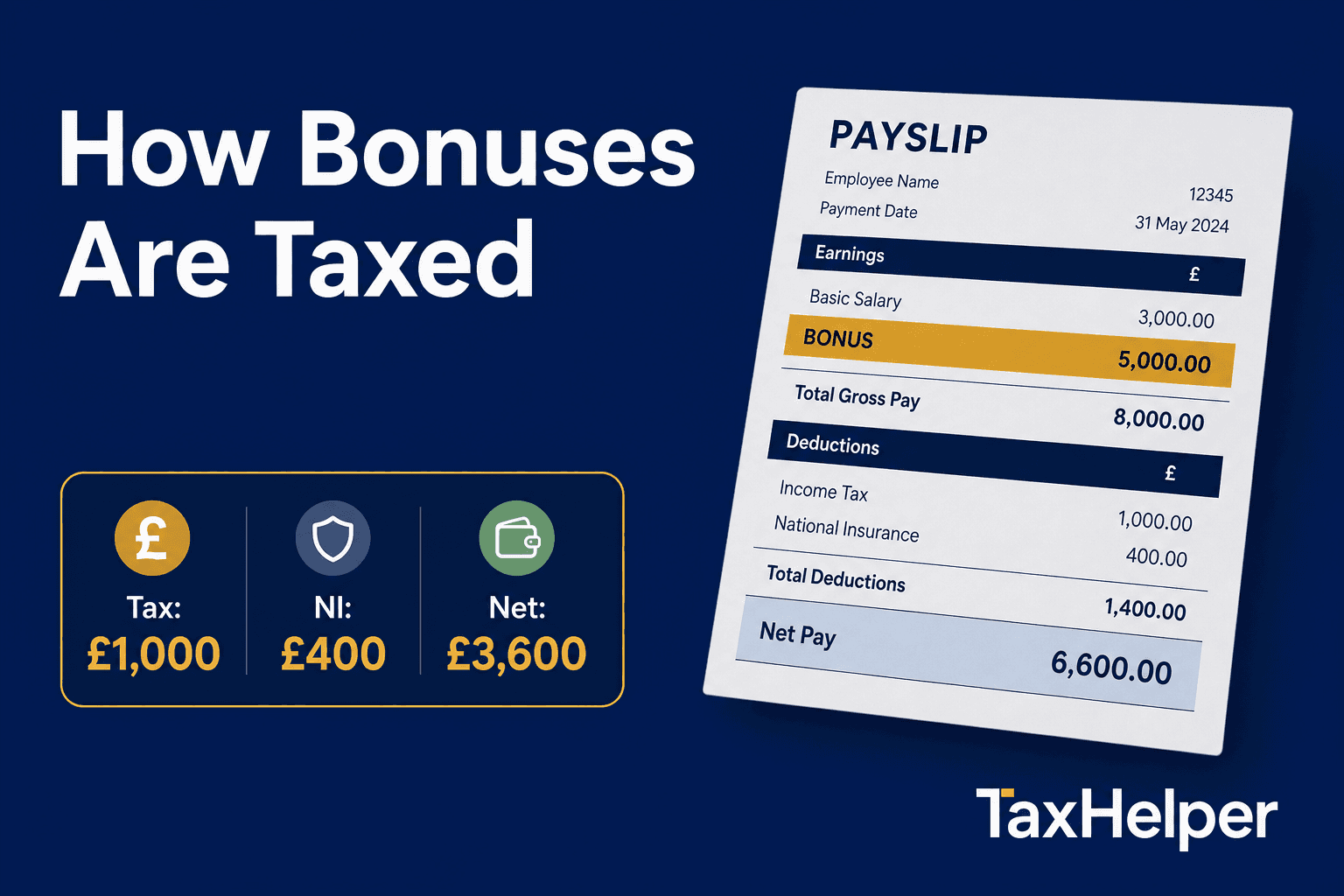
How bonuses are taxed in the UK
In the UK there is no separate "bonus tax rate". Your bonus is treated as employment income and added to the rest of your earnings for the year. You then pay income tax and National Insurance at whatever rates apply to your total income.
If your total income (salary + bonus) stays below £50,270, you pay basic rate (20%) income tax on the bonus. If it takes you above £50,270, the portion above that threshold is taxed at 40%. If it takes you above £100,000, you begin to lose your personal allowance — creating an effective 60% rate on each pound over £100,000 up to £125,140.
Example: £5,000 bonus on a £40,000 salary
Why does my bonus payslip show so much tax?
PAYE is calculated cumulatively each month. Your employer's payroll software looks at your total earnings so far this year and works out how much tax you should have paid in total — then deducts or credits accordingly.
When a large bonus arrives in a single month, the system annualises that month's pay (multiplies by 12) to estimate your "annual salary". This temporarily inflated figure may fall into the higher rate band, so it applies 40% on the bonus portion above the threshold. In the following months, once your regular salary brings the annual estimate back down, the system corrects itself and you are refunded the overpayment through a lower tax deduction in later payslips.
This means the total tax you pay across the year will be correct — but the bonus month's payslip can look alarming.
How to legally reduce tax on your bonus
Salary sacrifice into your pension
Ask your employer if you can sacrifice part or all of your bonus directly into your workplace pension. You save income tax and National Insurance on the sacrificed amount — and your employer may also pass on their NI saving. A £10,000 bonus into a pension costs you nothing in tax or NI instead of the usual £3,200–£4,200 in combined deductions.
Bonus via pension employer contribution
Some employers will match or contribute part of your bonus as an employer pension contribution. This is particularly effective as employer contributions are not subject to NI.
Protect your personal allowance
If a bonus pushes your income above £100,000, making a pension contribution equal to the excess can restore your personal allowance. Saving £1 of allowance is worth 40p in tax — so recovering the full £12,570 allowance is worth £5,028 in income tax.
Spread over two tax years
If your employer is flexible, asking for part of your bonus in April (start of the new tax year) rather than March can spread your income and potentially keep you in a lower band in each year.
Cycle to Work / EV salary sacrifice
Any salary sacrifice scheme reduces your gross pay before tax. Using your bonus period to maximise contributions to schemes like Cycle to Work or an electric vehicle lease can reduce your taxable pay.
Frequently asked questions
How much tax do you pay on a bonus in the UK?
Your bonus is added to your other income and taxed at your marginal rate — 20%, 40% or 45% depending on your total income for the year. You also pay National Insurance at 8% (up to £50,270 combined) or 2% above that. PAYE is calculated cumulatively, so a one-off large bonus in a single month can temporarily look like a very high tax rate.
Why does my bonus get taxed so much?
Your employer calculates your PAYE tax based on what your annualised income appears to be in that month. If you receive a £10,000 bonus in one month, the payroll system temporarily treats your annual salary as much higher, applying a higher marginal rate. This usually corrects itself in subsequent payslips as the cumulative calculation catches up.
Can I reduce tax on my bonus?
Yes. The most common approach is to ask your employer to pay your bonus (or part of it) directly into your pension via salary sacrifice. This avoids income tax and National Insurance on that amount. Alternatively, if you expect to earn more than £100,000 including the bonus, a pension contribution can restore your personal allowance.
Are bonuses taxed differently to salary?
No — bonuses are treated as employment income and subject to the same income tax and National Insurance rates as your regular salary. There is no separate bonus tax rate in the UK. The confusion arises from how PAYE temporarily applies a higher rate in the month the bonus is paid.
Sources
Calculate your take-home after a bonus
Enter your salary and bonus in our calculator to see exactly what you will receive after all deductions.